China’s Hospital Companions Learn Where to Draw the Line
SHANGHAI — When prospective clients contacted Li Shuping’s medical companion agency in Shanghai, their first question often had little to do with the hospital visit they were arranging.
“Patients used to ask first whether we were individuals or a legitimate agency,” Li tells Sixth Tone. Patients hire her company, Qingbeihu, to send a trained companion with them to hospital, helping with appointments, consultations, and paperwork.
The agency opened in September 2025, when almost anyone could advertise the same service on social media. And with people aged 60 or older accounting for 23% of China’s population by the end of 2025 and 59 million forecast to need care by 2030, more families were turning to companions to guide elderly relatives through hospital visits.
But written contracts were often absent, leaving services and fees unclear. Some patients faced unexpected charges once a visit was underway, with little recourse if they disputed them, prompting calls for tighter oversight.
But since Shanghai announced new rules for medical companion services effective July 1, Qingbeihu has received more inquiries, Li says. “Orders are growing steadily, and prospective clients seem more willing to trust the service.”
The rules cover medical companion services for Shanghai residents aged 60 and older and set requirements for worker qualifications, pricing transparency, and written contracts. They also require companions to wear identity badges, provide public lists of qualified agencies, and define responsibilities that include helping patients communicate with doctors and offering psychological support.
More recently, a national standard that took effect Nov. 1 covers medical companion services for patients of all ages across China. It also sets limits on what companions can do, prohibiting them from giving medical advice or making treatment decisions on patients’ behalf.
Following Shanghai’s new rules, Li says Qingbeihu now uses written risk and privacy agreements with patients and companions, as well as accident insurance for companions. For elderly clients unfamiliar with digital services, the agency also provides paper consent forms before a visit.
“Elderly people are very willing to have young people accompany them to seek care — it is also a kind of emotional support,” Li says.
For Qingbeihu’s six full-time companions, all under 30, the working day often begins as early as 5 a.m.
Patient work
By the time Li Suyu, not related to Li Shuping, meets a patient at the hospital around 7:30 a.m., she has already asked about their medical history, drug allergies, and mobility. She then checks registration details and organizes medical records and examination reports before the hospital opens at 8.
Once consultations begin, the 22-year-old accompanies patients to see their doctors, records treatment plans and prescribed medications, and arranges any examinations ordered. She also keeps family members informed and, after the visit, helps patients keep track of follow-up appointments and medication reminders.
In the afternoon, she takes patients for blood tests or ultrasounds, then collects their reports and mails them out. She often handles about 28 bookings a month, with as many as four on a busy day, each lasting two to four hours. At Qingbeihu, a two-hour booking costs 188 yuan ($26), while four hours of surgery accompaniment costs 360 yuan.
Li previously worked in sales and became interested in medical companionship after accompanying a family member to hospital and struggling with some of the procedures herself.
“I had no medical background, so even understanding the doctors’ terminology was difficult at first,” she recalls. When she encountered unfamiliar terms, she consulted more experienced colleagues.
At Qingbeihu, training covers first aid, hospital procedures, and organizing patient records. Companions also attend training at a Red Cross first-aid center and must pass an assessment organized by the Shanghai Association of Elderly Care Services and Aging Industry to obtain a medical companion certificate.
Much of the initial training is theoretical. Even after certification, newcomers must shadow experienced colleagues before taking bookings on their own.
“Many elderly patients become anxious in crowded hospitals, especially when they don’t know their way around,” Li says. She learned to calm them through conversation or small gestures, such as offering a bottle of water or some snacks.
One elderly patient with mid- to late-stage cancer initially refused to engage with her. He believed his illness was incurable and saw little point in spending money on treatment.
Li began talking to him about his family, listening as he spoke about his grandchildren. As he grew more comfortable with her, she encouraged him to continue treatment, reminding him that his relatives wanted him to recover. Li says he eventually agreed to cooperate with treatment.
Ma Xunru, a 60-year-old Shanghai retiree, had reservations when she hired a medical companion while her daughter was away on a business trip. She needed to visit a hospital for dizziness and cervical spine problems but worried that the companion might not be professional.
The crowds at the top-tier hospital made her dizziness worse. But her companion arranged appointments with two departments so she could see the doctors and complete the necessary examinations. Ma says that if she had gone alone or with her daughter, they would have registered with only one department.
“It was such a relief to have the companion with me. Otherwise I wouldn’t have known where to go,” Ma says. She now plans to use the service again.
“I think in the future I’ll ask my daughter to book a companion as well, so that I don’t need to bother her, since she’s busy with her work and life.”
Doctor’s orders
When Wang, a rehabilitation doctor in Shanghai, needed someone to accompany her for a gastroscopy, she hired a medical companion. Most of her friends were doctors, too, and asking one of them to come along would have meant rearranging a hospital shift.
She expected help preparing for the procedure and someone to talk to while she waited. “When taking the order, they only asked what time and where. And they were on their phone the whole time,” she recalls.
The experience helped prompt Wang, 25, to establish Zhuoyu Health with Zhou, 30, a gynecology and reproductive medicine doctor. Both asked to be identified only by their surnames.
Both had seen elderly patients struggle with hospital equipment such as self-service machines. Zhuoyu now has more than a dozen part-time companions drawn from rehabilitation, gynecology, anesthesiology, and the medical device industry.
Wang and Zhou found that questions they considered straightforward could leave patients at a loss, from what to do if they lost their ID card at a hospital to how to prepare for a CT scan. During consultations, they also help patients ask questions they might otherwise overlook and, afterward, understand their doctors’ instructions.
Wang’s first booking, in early June, involved an elderly woman whose health had suffered, she says, from using folk remedies during a long illness.
Before the visit, Wang and the woman’s son-in-law reviewed her medical records and the remedies she had been taking. With heavy rain that day, Wang rented a wheelchair for her. During an echocardiogram, she helped the woman adjust her clothing and explained each step.
Wang admitted to the family that she was handling her first booking. “I was very nervous taking my first order, and the patient’s family comforted me instead,” she recalls.
Zhou encountered a different problem while accompanying an elderly woman with poor hearing and limited Mandarin for a contrast-enhanced CT scan. The patient struggled to follow instructions requiring specific movements, and her anxious daughter began scolding her.
Zhou took the woman out of the examination room and explained what she needed to do. The second attempt went smoothly. “She wasn’t being uncooperative. She genuinely didn’t understand what she was supposed to do,” Zhou recalls telling the daughter.
Yang Hanxue, 25, decided to become a medical companion after seeing elderly people living alone and out-of-town patients struggle through hospital visits while she was working as a nurse.
Now at Qingbeihu, she adjusts her approach to different patients, explaining delays to those who are anxious, listening to those who want to talk, and keeping small talk to a minimum with people wary of the service.
Yang recalls a family wanting an elderly relative to undergo a full set of examinations, although the patient might not have been able to tolerate them. In such situations, she says, companions should remain neutral, relay the doctor’s advice, help families raise questions during consultations, and work toward an arrangement that accounts for the patient’s condition and the family’s wishes.
“Many people don’t understand this profession and mistakenly think we are experts, consulting us on how to treat illnesses,” Yang says. She tells patients and families to follow their doctor’s advice rather than offering treatment recommendations herself.
Wang recalls a patient who fell into a deep coma. The family eventually decided to discontinue treatment. Wang and Zhou say companions should not influence such decisions, but can offer support to relatives struggling with the choices they face.
Despite being a practicing doctor, Wang believes the boundaries of medical companionship need to be more clearly defined, particularly when patients ask companions to weigh in on treatment decisions.
“Patients often ask me, ‘The doctor recommended this — should I do it? Should I keep taking this medicine?’” she says.
Contributions: Marianne Gunnarsson; editor: Apurva.
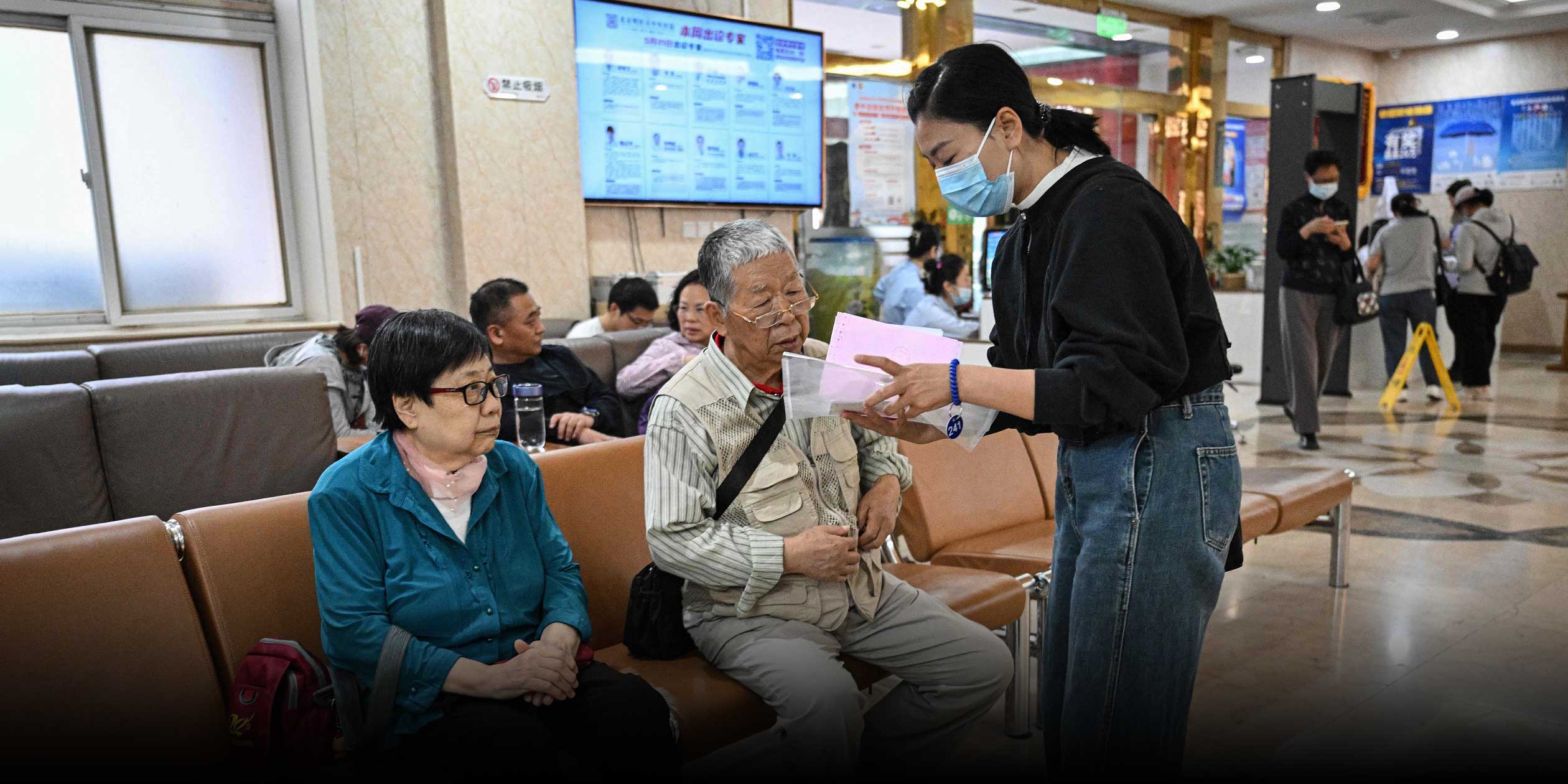
(Header image: A trained medical companion explains prescribed medication to an elderly couple at a traditional Chinese medicine hospital in Beijing, May 22, 2025. Jade GAO/AFP/VCG)